Before the last Presidential election, I wrote a comparison of the foreign policy situations under Joe Biden and the first Trump presidency. The short version is that the Biden administration had a comparatively much worse foreign policy approach and outcomes, with a more wars, less peace, and a decrease in America’s international standing. What does the situation look like after a year into the second Trump administration?
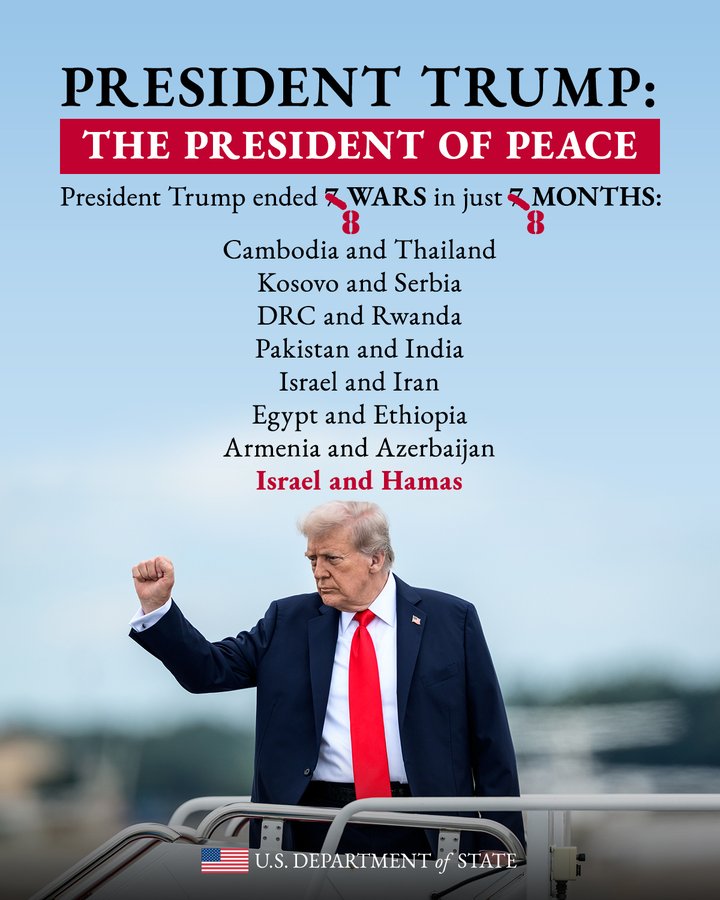
Let’s set some context. When running for office in the 2024 election, Trump strongly campaigned on his foreign policy chops. He claimed that Russia’s war against Ukraine would never have happened on his watch and that it would be an easy conflict to resolve once he became President again. He also claimed that he would be a President of peace, that he would end wars, and that he wouldn’t initiate new foreign wars. After coming into office, his PR machine started claiming that he ended several wars. Let’s see how he is doing compared to his own claims.
Cambodia and Thailand:
This looks like mostly a success. If we are to believe that President Trump was the one who mediated the ceasefire between these 2 countries, he should get the credit for that. There have been a few small violations of the ceasefire since it was signed, but it is mostly holding.
Kosovo and Serbia:
The situation seems to be the opposite of what the administration claims. From one perspective, it looks like Kosovo is making unilateral moves to stoke ethnic tensions. US relations with Kosovo are breaking down. And also, there wasn’t a war here in the last 7 months to end in the first place.
DRC and Rwanda:
It is meaningless to claim anything in a positive light here. On paper, some agreements were signed. In real life, reports are that no activities changed and both sides are funding violent militias/private armies to further their own goals. Nothing is resolved and there is no peace.
Pakistan and India:
This looks like a genuine success. India and Pakistan engaged in a real armed conflict, using modern high-capability weaponry. After the fighting ended, the Pakistani side gave President Trump a lot of credit for brokering the peace and the peace deal hasn’t been violated since then.
Israel and Iran:
I’m writing this on the weekend that Epic Fury was launched against Iran. No further comment.
Egypt and Ethiopia:
President Trump claims that he prevented a war, but nothing has been resolved and tensions are still rising. You cannot say that you prevented a war just because they weren’t shooting at each other before and aren’t shooting at each other now.
Armenia and Azerbaijan:
This is a great success. Not just the fact that there seems to be a legitimate peace agreement between countries that have been positioned against each other and fought wars against each other for the past 3 decades. But the fact that America was able to do this in what has traditionally been Russia’s sphere of influence is a major win for America against a primary geopolitical rival.
Israel and Hamas:
This can be viewed as a partial success. The large-scale fighting subsided, but Hamas repeatedly violated and continues to violate parts of the agreement. The full path to peace, rebuilding, and establishing a Hamas-free Gaza is not known. But the situation now is more peaceful than during Israel’s full offensive operations.
In total, out of 8 total wars that the administration is claiming to have ended, 3 of those claims look legitimate. There are many other aspects of world affairs that are not covered by a propaganda poster. Let’s look at them.
USA and Houthis:
The Trump Administration continued and expanded upon the Biden Administration’s idiotic policy of militarily engaging the Houthis in Yemen (Operation Rough Rider). The Houthis represented almost no threat to the USA or its interests. Very little of the shipping going through the Red Sea to/from the Mediterranean Sea is related to the American economy. It is mostly for trade between China and Europe. So the USA spent billions of dollars on high-end munitions like anti-air missiles and long-range stand-off attack missiles to protect China’s trade. If the Houthis were attacking Israel with drones and missiles, Israel has the capability to repel those attacks on its own. Besides that, the attacks on Yemen were ineffective.
Israel and Syria:
While not directly involving America nor impacting American interests, Israel’s unilateral attacks on Syria to send a message is not something that is an increase in world peace and this was an overall negative development.
USA and ISIS in Nigeria:
America spent a lot of expensive and valuable munitions (like Tomahawk cruise missiles) to attack non-government militias and rebels in Nigeria. These groups did not pose any danger to America nor did attacking these groups impact any American interests. These attacks were also performative and did not change the overall picture in Nigeria’s fight against its terrorists. It appears that the Nigerian government did not want this action taken on its soil until the very end, in order to avoid the appearance of unilateral American action on its territory.
Pakistan and Afghanistan:
This conflict does not directly involve America nor American interests, but it is bad for the world when there are neighbors bombing and attacking each other’s borders. This is another example of the increase in war in President Trump’s second term so far.
USA and Venezuela:
This started with a military buildup in the Caribbean where the American military was used to target supposed drug-running boats. This should have been a law enforcement action and many analysts believe this was a violation of international law. The USA then raided Venezuela to abduct its ruler, President Maduro, and take him to America and put him on trial. The USA did not impose a regime change and there are conflicting reports whether the current rulers of Venezuela are cooperating or resisting American policy in their country. Maduro was undoubtedly a terrible leader who oppressed, terrorized, and badly mismanaged his country to the benefit of himself and his inner circle. It is a geopolitical improvement for America if the current Venezuelan regime distances itself from Russia and China. But does America have a role in the world to go around and remove every oppressive leader? Especially those without the capability to harm America directly? I would think that based on our experience in Iraq, the answer would be “No”.
USA vs. The World regarding Greenland
This situation was and remains beyond absurd. The USA threatened to militarily annex territory belonging to one of its closest allies and an important NATO ally. I cannot believe that I wrote that, but I did. Eight countries (all NATO allies!) deployed a laughably small contingent of troops to Greenland as a show of unity against a potential American invasion. President Trump then threatened to implement tariffs against those countries. The Europeans were considering implementing their own financial measures which would have very bad ramifications for the American economy. In the end, after all the tension, threats, escalation, distrust, and loss of American credibility… an agreement that changed nothing was negotiated and the USA backed down.
Everything that the USA said during this conflict was complete and total nonsense. President Trump’s initial claim was that America needs to defend Greenland from Russia and China. It looks like this was made up arbitrarily and is not congruent with other policies and actions by this administration. There was one claim that the USA needed Greenland because of the rare earth minerals there and that Denmark neglected to develop those resources. This is wrong, Denmark has been actively encouraging companies to try, but it is not economical to do so. The Trump administration also claimed that owning Greenland was needed in order to build the Golden Dome missile defense system. The USA already has military facilities on Greenland for that purpose and has agreements with Denmark and Greenland where the USA can basically expand its military footprint on the island in an unlimited way.
This rise of tensions and loss of trust of our allies played right into the hands of our geopolitical rivals. The populations of some allied countries now view the USA as unreliable, relations as negative, and even view the USA as a threat. As part of the response to the chaos that the Trump Administration is causing, Europe has started to spend more money on its military (this was actually a goal of the American government) and to develop weapons systems that are free from American components solely for the goal of having systems that are free from American components. This has resulted in the USA threatening Europe to continue to invest in American weapons systems. You can’t make this up.
Is this what we want the outcome of our foreign policy to be?
USA + Russia vs. The rest of the civilized world regarding Ukraine
This is probably the most egregious and harmful piece of the Trump Administration’s foreign policy. Continuing the theme of loss of trust amongst allies, the Trump Administration has at times taken a pro-Russian, anti-Ukrainian policy. I have written previously on why supporting Ukraine is the most pro-America policy that can be taken in this situation. The Trump Administration has stopped donating weapons to Ukraine, cut off intelligence sharing with their military (which some analysts cite as a major contributing factor for Russia’s success in pushing the Ukrainian military out of the Kursk area) for extended periods, pressured the Ukrainians to take terrible “peace” deals which would destroy their country and allow America to profit from the aftermath, and tried to negotiate trade and business agreements with the Russians at the same time. Along with the Greenland fiasco, the American government’s embrace of Russia as anything but an antagonist has created a large amount of distrust in Europe (our primary geopolitical allies) which may never be repaired. It has also been highly ineffective and dealing with Russia with a light touch will not be a policy to produce a positive outcome quickly.
It is important to note that taking an anti-Russia policy is not only pro-American through the lens of supporting Ukraine in its fight for independence. It is important to understand that undermining America and destroying its influence is a key Russian goal. There is a good chance that if you are reading this, you are American. And there is a good chance that if you are American, you don’t spend more than 30 seconds per decade thinking about Russia. Russia is simply a non-factor for the majority of Americans and has not been a focal point of American foreign policy for a long time.
However, reducing the influence, reach, capabilities, alliances, and overall standing of America is a central position of Russian foreign policy. This is not a recent position that is tied with Russia’s war against Ukraine, this sentiment goes back decades. It is vital to understand what the outcome would be for Americans. A lower quality of life, less access to trade and economic markets, more wars and subjection of smaller countries by regional powers, less certainty about the applicability of international laws and norms, and more frequent cross-regional wars.
Like the situation can often develop in autocracies, the Russian government has turned America and the “collective West” into the boogeyman that is ailing their society. Many ordinary Russians believe that America is actively holding back their development and wants to destroy Russia. In this context, it is simply disgusting and self-destructive to see President Trump embrace Putin, the architect of an anti-American policy and someone who is actively trying to destroy a world order that benefits the American people, as a preferred business partner to the detriment of Europeans who are allied with America and share America’s values to a large extent.
Trade Wars:
One global issue that was kicked off by the Trump administration that has been tremendously harmful to America has been the international trade war that was kicked off by President Trump at the start of his term. This includes tariffs and negotiated concessions in new trade agreements. This wasn’t done against America’s rivals to weaken them, this was done against America’s allies and all countries! This post covers mostly military conflicts and I will not go into the economic and financial aspects, but it is overall not a peace building measure to start trade wars with your allies and potential allies.
Conclusion:
So what can we say about foreign policy in the first year of Trump’s presidency? The past year has seen an increase in armed conflicts across the world. There is less peace and stability now compared to the previous year. The USA, especially in its conduct relative to Europe, has lost a lot of support and suffers from a lower standing than before. Of course, the USA has also started another war of choice in attacking Iran. Promises of peace have proven to be false both for the USA and for the rest of the world and this administration has alienated former steadfast allies. If you voted for Trump, this is most likely not what you wanted.