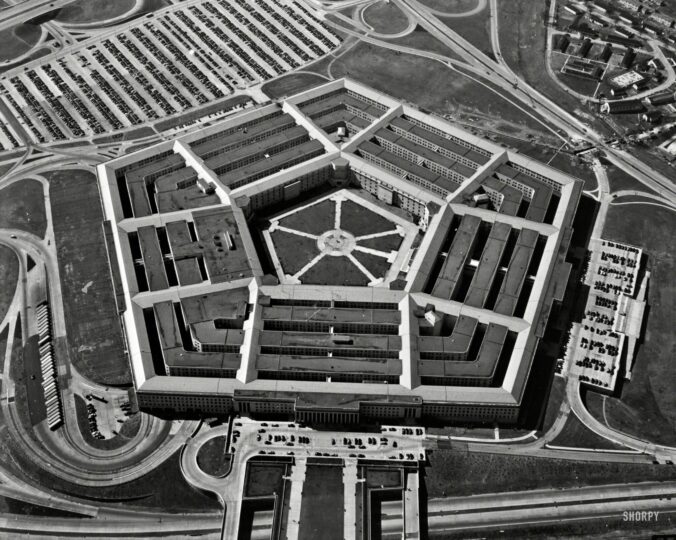
The United States spent $826B on the military in 2024. Of that total, $423B (roughly 51%) went to procure products and services from non-government companies (these companies are referred to as “contractors”). Some of these contractors are small mom-and-pop, private businesses. Some are multi-national, multi-billion dollar public companies. Some of these companies’ products and services are sold exclusively or almost exclusively to the government (like fighter jets). Some of these companies make products that just happen to be bought by the US government but are available to any customer (like pens and pencils). There are many problems and inefficiencies with the way the government buys products and services from contractors.
Could nationalizing some of these companies lead to better outcomes in terms of product delivery, execution, and financial efficiency? Could growing the size and scope of the government in this way lead to savings for the taxpayer?
- Intro
- Problems with Defense Contracting
- How Nationalization Helps
- Potential Issues with Nationalization
- Conclusion
Intro
Military-Industrial Complex
Five American companies dominate the defense field when it comes to getting revenue from the US government. They are Lockheed Martin (LM), Boeing, RTX, General Dynamics (GD), and Northrop Grumman (NG). Between them, these Big 5 companies offer every military product under the sun including helicopters, bombers, missiles, tanks, satellites, sensors, radars, and much more. This document will focus primarily on these companies, but there are many other sizeable firms that exist primarily to sell products and services to the government.
What is Nationalization?
Nationalization is the process where the government takes over a non-governmental business. Nationalization is not a theoretical construct, it has been a historical reality when collectivist, redistributionist, authoritarian governments take power in previously free-market societies. In the Soviet Union and Cuba, the Communist governments took over private businesses and farm operations after their respective Communist Revolutions. In more recent history, the government of Venezuela nationalized or expropriated the Venezuelan operations of several multinational companies including ConocoPhillips and ExxonMobil.
Nationalization is generally viewed negatively when it follows the Soviet or Venezuelan models since it is governmental theft of private property from private individuals. The results are usually negative. Examples from Soviet agriculture and PVDSA (the Venezuelan national oil company) show that economic productivity under government ownership drops. This is due to several factors including the removal of competent managers from operational and decision making roles, the appointment of inexperienced managers, shifting incentive structures from business to ideology, and corruption.
If nationalization is generally viewed poorly in free-market economies and as the opposite of free-market ideals, then why could it be a reasonable step for the American defense industry? If we generally view government takeovers of General Motors (GM) and Pepsi as negative, then why should we want to nationalize RTX or Boeing’s defense business? The key to this argument is looking at the flow of money and the implications on whether something is “free-market” or not.
Why Nationalization?
Let’s start by looking at Coca-Cola (CC). Every dollar that CC gets as revenue is a voluntary purchase from a consumer in an open marketplace. As an individual, I have the choice to buy CC products, or Pepsi products, or no products at all. The government does not have any say in that and CC itself cannot compel me to give them money. It is possible that CC sells products to the government either directly or through a distributor, but that is not the core of their business or their existence. If one day, all of humanity woke up and decided to put CC out of business, billions of individuals could make the choice not to buy CC products and there is nothing any government or CC itself could do about that.
Now, let’s look at Lockheed Martin. According to the 2024 numbers, they had revenues of $71B. Of that total, $52B was sales to the US Government, $484M was to US Commercial customers, and the rest is categorized as International (which is not broken down by commercial vs. government sales so I will ignore that number). LM generates 107x more revenue from US Government sales than US commercial sales. Its non-government revenue is negligible and has very little material impact on its business. To put this another way, all of LM is funded by taxpayer money and the company would not exist without the government taking money from people like me and you and transferring it to LM.
The other companies in the Big 5 have some lines of business that are either purely commercial or mixed government/commercial, but they all have substantial divisions/business units that are entirely dependent on taxpayer revenue to create products for the military. The numbers would need to be teased apart with more nuance but the same concept applies for those lines of business.
You and I have no choice in giving our money as revenue to LM or and LM does not exist without taking our money with/without our consent. Our money as taxes is taken from us by force. If you don’t pay taxes willingly, the government can put you in jail, take the money directly from your bank/paychecks, etc. If you do not want your taxes to go to LM, you cannot, in any way, affect that. Our money is taken from us without our consent to fund the profits of private corporations. That is the fundamental difference between the business of the defense companies and almost everything else in our economy and why the free-market principle of privatization is counter-intuitive in this case. These defense companies are not true free-market entities and military procurement is not a free-market enterprise.
There is a reasonable counter-argument to the point around taxpayers having a choice for where their tax money is spent. America is a system where we vote for representatives to execute on our desires and interests in the government. So if we feel like NG should be awarded a project instead of LM or that the project should be cancelled, we need to vote for representatives who hold the same views and act on those views. I will discuss later why this model is broken and precludes a happy outcome for you if you want less defense spending or at least more efficient defense spending.
Another counter-argument is that nationalization won’t solve the problem of inefficient spending and poor outcomes. After all, we have many examples of extremely poor internal execution and spending by the government and the government is generally not incentivized or required to spend money in the most efficient way possible. However, it can be possible that by nationalizing certain defense companies, we can make spending less inefficient by removing certain incentives and cost structures. This will be discussed in more detail later.
The government generally provides its services without business incentives. The government is not trying to maximize profits or please shareholders with stock price growth. And because of that, there are artifacts from the private business world (profits, stock-based compensation, bonuses tied to company performance, shareholder dividends, internal company treasury investment operations, etc.) that are not applicable to government organizations. All of those things exist for non-government businesses. So why should a company that is entirely or substantially taxpayer funded and only does work for the government have things like profits, executive bonuses, or incentives driven by shareholders?
There is no problem with the CEO of Pepsi getting a massive yearly bonus and buying a Ferrari. That person earned that money based on a system of voluntary agreements and transactions. I could have chosen to participate if I wanted to (buy a Pepsi, buy a Coke instead, buy Pepsi stock, short Pepsi stock, etc.) or not participate if I didn’t want to. I do have a massive problem with the CEO of LM getting a bonus and buying a Ferrari because a) that money came from my pockets without my consent and b) that Ferrari money could’ve been spent on getting a better value for the taxpayer instead. This is the crux of the argument for why nationalizing defense companies that entirely/mostly derive revenue from the government (taxpayers) could be a positive free-market solution.
A company acting as an extension of the government should just be the government without all of the additional expenses and business incentives of non-governmental companies.
We won’t discuss the specifics of how nationalization should occur. There are a few forms in which this can happen; buying out all of the shareholders to get full control of a company, compensating the owners for seizing a business, marching troops into the business and dispossessing the owner without compensation, etc. We also won’t discuss specifics of what the post-nationalization structure should look like. There are a few options for this including transforming all of the former-business employees into government employees, mostly keeping the existing business structure with the government becoming the shareholder, and some options in between. These are all interesting questions but the focus here will not be to analyze or advocate for any particular approach. We will explore the current problems with defense industry procurement as it relates to private industry, some reasons why nationalizing defense companies could address those problems and potential alternatives to nationalization to solve those problems.
Problems with Defense Contracting
There are quite a few issues with the way the government buys services and products from defense contractors today. Some of these problems are political and lie with politicians. Some of these problems are behaviors by the contractors due to the incentives they have and objectives they pursue in the current system. Do you like NASA’s civilian space program? Boeing’s SLS rocket is a waste of tens of billions of dollars and makes space access more expensive while suffocating other areas of NASA’s budget. Are you an American pacifist? Your money still contributed to the weapons used to kill civilians in Iraq.
Wasteful Spending
An interesting aspect of the American budgeting process for the military is that Congress does not just allocate funds requested by the military for things requested by the military. Congress can also pass budgets forcing the various military branches to buy things that those branches don’t want to buy. Also, Congress can block a branch from divesting/scrapping/selling its assets. Politicians are driven by various incentives to do this.
Let’s say that the USAF identifies a need to buy 10 F-15 fighter jets from Boeing and requests a line item in its next yearly budget to buy these 10 planes. Boeing is happy that it is getting an order for 10 planes. But what is even better and more profitable than selling 10 airplanes? Selling 20 airplanes. So Boeing will treat the Congress members responsible for authorizing the USAF budget to nice steak dinners, lovely games of golf, and very generous donations to re-election campaign funds. And the Congress members will tell the USAF professionals that their budget request is wrong and that they need 20 airplanes, not 10 airplanes. So the USAF will need to use its budget to acquire an additional 10 planes that it doesn’t need.
In another scenario, which is purely fictitious and I’m sure would never happen in reality, the USAF has identified that it can save money (the savings are badly needed to pay for 10 unplanned, extra F-15s being added to its fleet…) by closing an air base which does not provide it enough practical or strategic value to justify its cost. This greatly upsets the Congress members from the state and district where the base is located. If that base closes, then the district will lose the jobs that support that base. If hundreds of people get a lower quality of life from losing their jobs, they will be angry and upset. And that anger will be targeted at their Congressional representatives and those representatives will lose votes. So it is better for the political careers of those representatives to fight for an unneeded USAF base to remain open.
https://www.stripes.com/branches/navy/2022-06-07/navy-ships-retirement-plan-congress-6262625.html
Corruption
Unfortunately, corruption in the defense procurement process is real. Straightforward bribery is one type of corruption. If LM wants to win a contract to develop a new airplane for the Navy, it may try to bribe (with a large amount of money) the Navy official in charge of procuring this aircraft. Another form of corruption is indirect bribery. LM might not offer the naval official anything at the time of the contract decision. However, there might be an understanding that when this official retires from the Navy, they will get a lucrative senior leadership role at LM. Why does bribery like this happen? The incentives (increased revenues and profits, higher share price) to engage in corruption are adequate enough to do it.
https://kkc.com/frequently-asked-questions/what-is-defense-contract-fraud/
https://www.sba.gov/article/2025/11/14/defense-contractor-executive-sentenced-bribery-scheme
https://en.wikipedia.org/wiki/Darleen_Druyun
Bad Outcomes
Concurrent procurement (when design, production, testing, and operational use happen in parallel instead of sequentially) practices have led to the delivery of systems unfit for use while being extremely lucrative for the contractors developing those systems. Concurrent procurement and cost-plus contracting practices have resulted in the delivery of many dozens of F-35 fighters (each one costing nearly $100M) into the Air Force inventory which may never be approved for combat use due to all of the defects and deficiencies in their design and manufacture which were not properly identified. The Navy’s next generation Ford-class aircraft carrier has been designed and built without the basic validation that the technology for its new aircraft catapult/arrestor system, EMALS, works. The result is a mostly completed aircraft carrier which cannot launch or recover aircraft. All of these nightmare projects are extremely profitable for the defense contractors responsible for them.
https://www.twz.com/avoiding-f-35-acquisition-malpractice-aim-of-next-gen-air-dominance-fighter
Political Money Cycle
We need to look at the defense procurement money cycle to identify the cause of the bad behavior and bad outcomes. This is perhaps the most egregious, sinister, anti-free market, and objectionable aspect of the system.
You pay taxes to the government. The government uses some of your money to fund the acquisition of products and services from a defense contractor. The defense contractor uses a portion of this money on the development and delivery of the products and services it is contracted to deliver. The contractor does not offer its services “at cost” so it will take in more money than its services cost. With a portion of this “excess” money, the contractor will engage in political activity. The contractor will hire lobbying firms to lobby existing Congress members to pass budgets to increase funding for items which would benefit the contractor. The contractor also funds the election campaigns of candidates who support increasing the budget in ways which would benefit the contractor. With the success of these political efforts, Congress will continue to create and pass larger budgets that contain ever more and more spending that is beneficial for the contractor. Larger budgets mean larger taxes burdens and/or more money printing (aka borrowing – this also reduces citizens’ wealth through the inflationary impact of the increased money supply). And now the cycle repeats itself and you (the taxpayer), will pay (higher) taxes again.
Your money is taken from you to be used by private companies to advocate for policies to take more money from you. This is an escalatory loop and you do not have any say in this. The taxpayer is essentially forced to pay taxes to marginalize their own voice and an easy recourse to break the cycle doesn’t exist.
To put this another way; companies are using money taken from you to pay for politicians who create policies to take more money from you and give that money to those companies. Your ideology does not matter and it does not matter which party you vote for. These companies donate massively to all political sides and it is unrealistic to expect that a majority of politicians will develop policies that run against this system.
Because of the nature of this cycle, the argument that there is some free-market dynamic where we are choosing how our tax dollars are spent based on the representatives we elect falls flat for the defense industry. There is nothing free-market about a system divorced from normal business incentives and consequences, a system that can create any amount of arbitrary revenue for itself, a system predicated on the legal supremacy of the government to perpetuate it. Pepsi could only dream that the government could force people to buy its products.
https://www.opensecrets.org/news/reports/capitalizing-on-conflict/defense-contractors
Intellectual Property and Customer Rights
One particular topic that is becoming more important as weapons systems rely more and more on software (this topic is also very important for the hardware as well) is the ownership of the Intellectual Property (IP) rights associated with the acquisition of a weapons system. This is not just about signatures and names on a piece of paper, this has very real impacts in procurement and the field.
By holding on to the IP rights of something that is sold to the military, the contractor can ensure that the military cannot fix the thing on its own and must rely on the services of the contractor for repairs and ongoing sustainment. This means that the original contractor has locked in large sustainment and services contracts which cannot be bid on competitively since that vendor is the only one with the technical know-how to service their product. This is wasteful and unnecessary since military personnel could be trained to do more maintenance and repair tasks without needing to call in technicians from these private companies. This only benefits the bottom line of the private companies at the expense of the taxpayer.
Equally as important as being able to physically repair equipment is the notion of data ownership and governance for software systems. Some poorly negotiated contracts have put the military in the tough position of not owning their own data or being fully reliant on the contractor to extract the data that they do own out of the contractor’s systems. This should be completely unacceptable from a security and readiness point-of-view.
If we look at it morally, the military should not be in a position where it is unable to repair the equipment it paid for nor own the data in the computer systems it paid for. You can make an argument that John Deere should be able to sell tractors to farmers and make the hardware and software not repairable by the farmer. But there isn’t an argument that it is ok for the military to be in the same spot. The IP that belongs to the contractors only exists because of taxpayers paying for it. It should be used for the benefit of the taxpayers to make sustainment efforts as inexpensive as possible, not as another revenue stream for a company to squeeze in the hopes of a higher stock price. This is a massively important topic and the industry lobbies and special interest groups are already putting out propaganda to counter the “right-to-repair” narrative.
https://www.nytimes.com/2019/11/20/opinion/military-right-to-repair.html
https://prospect.org/2019/09/19/when-big-business-wont-let-the-troops-repair-their-equipment/
Industry Consolidation

The number of defense companies has decreased to create huge conglomerates. Consolidation for the Big 5 has reached somewhat of an equilibrium since the early 2000s, although it is not completely done in the defense industry, see examples below. The government would most likely not allow (I won’t be surprised if this prediction will be wrong) greater consolidation amongst the Big 5 since the resulting entity would become completely dominant. The government also doesn’t want any of the current Big 5 to get too weak and fail relative to their competitors. Some analysts argue that certain companies get certain contracts just so the contractor can get the work as a counter-balance against another contractor, not because that contractor is the best choice to execute on the contract. This is unnatural for a true free market system.
https://www.defensenews.com/air/2023/07/28/l3harris-closes-purchase-of-aerojet-rocketdyne
https://boeing.mediaroom.com/2017-11-08-Boeing-completes-acquisition-of-Aurora-Flight-Sciences
RTX itself is a result of a massive, $100B merger: https://en.wikipedia.org/wiki/RTX_Corporation#Raytheon_Technologies
https://investor.northropgrumman.com/investor-resources/orbital-atk-acquisition
https://www.gd.com/Articles/2018/04/02/general-dynamics-completes-acquisition-csra
An example of industry consolidation gone awry is United Launch Alliance (ULA). Boeing and LM each had competing heavy-lift rocket launch businesses to launch satellites for primarily military and intelligence (with some other government and private sector business) customers. These companies were forced/allowed to merge these lines of business in 2006 into a 50/50 joint venture, ULA. This was done for several reasons but one of the main reasons that the companies presented was that the Air Force would lose American national heavy-lift capability entirely unless the companies were allowed to merge since their respective business could not survive if they had to compete against each other. ULA’s creation resulted in a near-monopoly with incredibly high costs, minimal innovation, and constant political lobbying to prevent competitors from bidding and competing with it for government business. SpaceX had to sue the government to be allowed to compete for some its first government launch contracts after ULA lobbied for SpaceX’s exclusion, evidence of a government-enabled defense monopoly acting creating a situation that does not correspond to a free market.
How Nationalization Helps
There are two primary factors for how defense industry nationalization can help address the problems that have been brought up. The first factor is that the incentive structure changes; profit is removed from the equation. The second factor is the simple reduction and simplification of cost structures related to the development of weapons systems if the corporate structure is eliminated.
Incentive
All of the negative behavior that has been brought up stems from one root cause, the incentive for non-governmental companies to make a profit. Why is there corruption? Does the company offering cash payouts for a favorable political decision engage in this behavior because it is good to be corrupt? No. It is a simple business investment. The contractors are trying to generate profits. They are trying to show business strength so that the share price goes up. Even expensive bribes could be good investments if the potential benefit from those bribes is lucrative. Even getting caught committing bribery and being fined/penalized for doing so could be considered a good investment if the bribe and fine is proportional to the potential benefit of winning the contract.
Why do we have the political money cycle? It is because corporations view it as a good investment to spend money on lobbyists and campaign contributions in order to increase their profit potential. They spend a portion of their existing capital with the hopes that it will pay off with the creation of policies/politicians that will funnel additional taxpayer dollars back into those corporations. Why does Congress sometimes insist on the military buying more equipment than it actually needs? Because the lobbying efforts of the corporations lead to politicians being convinced to spend more money on those corporations’ products, increasing the revenue and profit for those corporations.
Financial Structure
There are various financial activities that publicly traded private companies engage in that would not be possible when operating as part of the government. Some stocks pay dividends, which is capital directed to shareholders. Since there wouldn’t be any publicly traded stock, there wouldn’t be any dividends to pay to private individuals using taxpayer funds. Some companies use their internal funds to buy their own stock from the public markets. The theory behind this behavior is that the stock price and financial metric around the stock will improve if the publicly available supply of the stock is reduced. Again, this behavior would not be possible since these companies would be incorporated into the government and there wouldn’t be publicly traded stock. Companies also engage in things like issuing bonds or taking on debt loans to fund their operations and strengthen their balance sheets. Individual organizations within the government don’t engage in this behavior so making periodic debt payments to private investors/banks with taxpayer dollars wouldn’t be required.
By removing the corporate incentive for profit for the development of a certain product, it is reasonable to believe that the overall cost of that product would be lower when the corporate profit is removed. If a company sells a $100 item and makes $10 of profit on that sale, then we can say that the item would be $90 if it were to be sold at the break-even level. If we look at just the 2024 Lockheed Martin example, they generated $7B in free cash flow on their $71B of revenue. That is $7B of excess taxpayer money that was redirected to a private company’s bank account. Lockheed Martin also spent $6.8B dollars in stock buybacks, a self-enriching activity that provides no benefit to taxpayers while being funded completely by taxpayers.
Getting rid of the corporate structure and subsuming the development of defense systems into the government also changes the cost structure for the cost that it takes to run and operate the organization. Think of making that new tank for the Army. You still need the designers, engineers, and testers as before. But there are many other functions in a company; HR, finance, legal, sales, marketing, various executives. Are all of these roles needed if the company becomes a government organization?
In addition, the organizational structure could be simplified and lightened. Executives would mostly not be needed. As a broad statement, an executive at a large company is responsible for aligning corporate resources to desired business outcomes. If we do not have a desired business outcome due to being part of the government, then we can eliminate or significantly reduce the amount of very expensive executive-level people that we have.
Potential Issues with Nationalization
There are many potential problems when talking about transitioning from a private ownership company model to a government run organization model. Some of these are general questions, some would depend on the specifics and nuances of the approach taken. We can anticipate and start thinking about some of these problems.
- Loss of competitiveness/innovation, how do you keep incentives? The profit motivator pushes companies to come up with new technologies and processes to be more competitive than their rivals. What would motivate continued innovation if there wasn’t competition from other companies? What would be the incentive to make a world class product if your survival doesn’t depend on it? Maybe continuing to have multiple teams compete for projects (with winners getting compensation bonuses) could be a way to address this.
- Potentially higher overheads to keep unprofitable actions going in order to maintain a capability. ULA is an example of this. The government paid a $1B yearly subsidy to ULA just to keep alive their heavy-lift launch capability, paid regardless of demand for their services. We wouldn’t want to devolve our defense industry to be subsidized for not doing any work or have unneeded work assigned for political reasons (a Senator doesn’t want a factory to close in their state) or to prevent technical atrophy. Some kind of safeguards in legislative policy or an equivalent mechanism would need to be established so that only work that is really meaningful gets funded. This is easy to write on paper, but given how things are done, maybe practically not doable.
- How do new entrants compete? If I have a fantastic idea for a new tank concept as a private citizen or a private company, how do I go about making that a reality? Would this enterprise be consumed by the government as soon as it presents its idea? Then what is the point of being an innovator in the defense sector? What if a new entrant sells a new product to the government as their sole revenue even if it is a dual-use product that they also want to sell commercially, do they get automatically nationalized? A potential way to address this could be some kind of carve-out for companies under a certain threshold for revenue/age/size.
- How does the government determine whether a COTS solution is appropriate? If the Army has a need for 50,000 pens, it might be simple to say the answer is to buy a bunch of Bic ball-point pens from OfficeMax and call it a day. But what if there is some special requirement for these Army pens that a civilian Bic pen doesn’t meet? Would the Army then launch an internal development program to develop its pen? How do we know that the special requirement is even valid and necessary for the use case and is not being used by an “enterprising” bureaucrat to grow their domain? Should COTS solutions be favored or the default policy according to law? Then how do we avoid the current situation where COTS providers would lobby for the purchasing of what they make instead of internal developments? Should internal developments be favored by default? Then how do we avoid the situation of locking out valid private industry solutions? This balance would be very difficult but very important to get right.
- What about a company like Anduril? They make military-focused COTS products that are not dual-use. Even though their revenue will be either primarily or wholly derived from the government, they are purposefully adopting a different business model than the Big 5 by developing COTS products with their own funds and then selling those products for a profit. It is philosophically difficult to say they should be nationalized as well since their intention is a business model that doesn’t screw over taxpayers like the Big 5 do. How do we deal with that?
- What is the criteria for a defense enterprise to get nationalized in the first place? Is it some revenue number? A headcount number? A contributing factor of what % of revenue comes from government sales versus commercial sales? Would companies need to be broken apart based on divisions/business units in order to make the determination based on the different variables for different lines of business?
- How are international sales handled? Selling US-made weapons to other countries is big business for the large defense contractors. For example, the F-35 fighter jet has been sold to 19 countries, the older F-16 fighter jet has been sold to 27 countries. What would the process for international sales look like under a nationalized model? Would the sales be for a profit going to the government? Would the government allow licensing of designs and technology to other countries?
- There are numerous examples of joint development efforts with foreign companies and governments, like the F-35 fighter, the Joint Strike Missile (JSM), and National Advanced Surface-to-Air Missile System (NASAMS). How would these joint development projects look like in a nationalized model? What would be the incentives, drawbacks, and limits of international development efforts?
- Although this is not very common, sometimes a civilian, demilitarized version of a military product gets sold in the commercial market or to non-military government organizations. An example of this is the thousands of Bell 204/205/212/412 helicopters, derived from the UH-1 Huey military helicopter, which have been sold across the world. How would any derivative civilian versions of relevant military products be developed and sold under a model where the government controls the defense industry? Having the government compete in the marketplace of goods for civilian products is not a desirable free market solution.
- In a government run corporation system, how do you avoid the same problems as with the US Postal Service? Some of the capability and services of the USPS overlap with private companies like FedEx and UPS. But those companies don’t have the same legislative restrictions to encumber their business models. USPS’ cost structure is not determined by the market but rather through Congressional legislation. The same applies to their revenue model, they have limited flexibility in determining the prices for their services. In a nationalized defense industry, how would we avoid the same problem where costs and revenues are set as part of the legislative process that is decoupled from operational realities?
Conclusion
Current Approaches
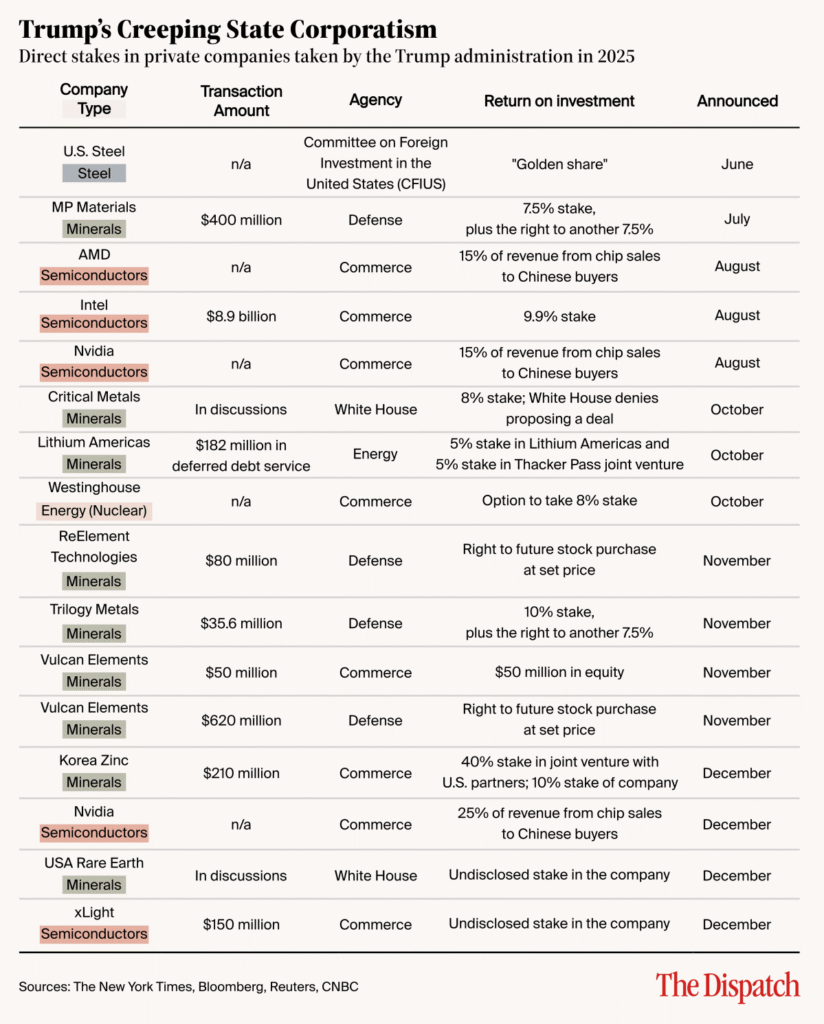
The current administration sees that there are problems with military procurement and is at least discussing taking some actions. But like with many topics being tackled by the second Trump Administration, they have some ideas of some concepts of some plans of some actions that might be in the ballpark to being adjacent to making sense but the actual proposals (and the execution that those proposals would entail) are deeply flawed. The primary tool that is being discussed is the government taking stakes in private companies, including Lockheed Martin.
https://www.cnbc.com/2026/01/24/us-rare-earths-miner.html
https://www.cnbc.com/2025/08/26/trump-pentagon-equity-stakes-in-defense-contractors.html
The government has correctly identified that Lockheed Martin is “basically an arm of the U.S. government” but the remedy is potentially a worst-of-both-worlds approach. The negative aspects of the profit-making motive remain while adding additional oversight and political influence from the government. This is the antithesis of an effective free-market solution and intertwines business and government interests with taxpayers caught in between and without any advocates for their interests.
To the administration’s credit, they have raised some of the issues we’ve examined like stock buybacks, executive compensation, and dividends. But making a kludgey part-government, part-private system with band-aids made out of executive fiat is not a proper, structural approach. The government should not be taking stakes or making investments into private businesses.
https://www.cnbc.com/2026/01/07/trump-dividends-stock-buybacks-defense-companies.html
https://www.twz.com/news-features/pentagon-is-making-a-naughty-or-nice-list-of-defense-contractors
Are there other ideas that could be implemented to tackle those problems? Absolutely. Legislation can be created to add more oversight and accountability for contractors without the government putting in money to partially control those companies. We certainly don’t want to see a repeat of 2018 where NASA paid Boeing a $271 million performance bonus for the SLS program which at that point was years behind schedule and billions of dollars over budget. Funding mechanisms and acquisition models can be made more restrictive (non-fixed fee contracts only be exception, remove the ability for Congress to force the military to buy equipment and services it does not want, no more concurrent development practices, limit scope changes by the military after contracts are signed, etc.) in order to bring fiscal discipline and reduce development risk.
Are there other countries where the defense industries are intertwined with the government? Yes, India, Russia, and Israel are just a few of the countries where the major military suppliers are in some form owned wholly or partially by the government. We can learn from those countries about what NOT to do as much as we can learn what concepts may work. Israel’s defense industry seems pretty well managed, with a good balance of allowing for corporate profits while delivering efficiently. Russia on the other hand is a story of what not to do. The state owned firms must complete Russian-government contracts first before fulling foreign export orders. This creates major financial problems as the Russian-government contracts usually stipulate near-cost or sometimes sub-cost compensation for those companies. Foreign orders are more lucrative and bring large margins since the price that can be charged for foreign orders is unrestricted. So even with large revenues coming in, the defense companies are usually very unhealthy and laden with debt since it is unprofitable to work on the government contracts, which they must execute on before working on profitable foreign work. Let’s not create that system in America.
Final Thoughts
Does an approach like defense industry nationalization solve all of our defense planning and procurement problems? Would it get rid of things like wasteful spending, requirements churn, overlapping & competing procurement programs, political meddling, and corruption? No, it is not realistic that those things would totally become a thing of the past.
Could there be significant downsides to a nationalization approach? Yes, any such fundamental change in such a large part of our government, economy, and society could have bad consequences. But it is a reasonable idea to examine, learn from, and on which to base an analysis. Why? Because even if it doesn’t completely fix all of our problems in military acquisition and development, I want to see what a model would look like where a CEO’s bonus money for a new yacht is not the consequence of their company destroying taxpayer money in wasteful defense spending, mismanagement, and poor execution.